CULTURAL GUIDE
The Đám Hỏi Ceremony: Everything You Need to Know Before Your Vietnamese Engagement
From mâm quả traditions to modern logistics — a professional planner’s guide to the ceremony that officially unites two Vietnamese families.
In the rhythm of a Vietnamese wedding, the đám hỏi — often called the engagement ceremony or lễ ăn hỏi — is the event that carries the most cultural weight. It is the formal moment when the groom’s family presents gifts to the bride’s family, asks for official blessing, and both sides publicly commit to the upcoming union.
For couples living abroad, this ceremony often raises the most questions. What gifts are expected? How many trays? What does each family contribute? We have guided hundreds of families through this process across three regions of Vietnam, and this guide distills that experience into clear, practical advice.
THE CEREMONY EXPLAINED
What Makes the Đám Hỏi Different From Other Wedding Events
The Vietnamese wedding journey typically includes three major ceremonies: the lễ dạm ngõ (door-knocking visit), the đám hỏi (engagement ceremony), and the tiệc cưới (wedding reception). While outsiders sometimes confuse them, each serves a distinct purpose — and the đám hỏi sits at the center.
Where the dạm ngõ is a quiet, private family visit, the đám hỏi is a public declaration. The groom’s family arrives at the bride’s home with a formal procession — young men and women carrying decorated trays of gifts — while the bride’s family receives them at the door. There are speeches, the exchange of gifts, ancestor prayers, and often a tea ceremony where the couple pays respect to elders from both sides.
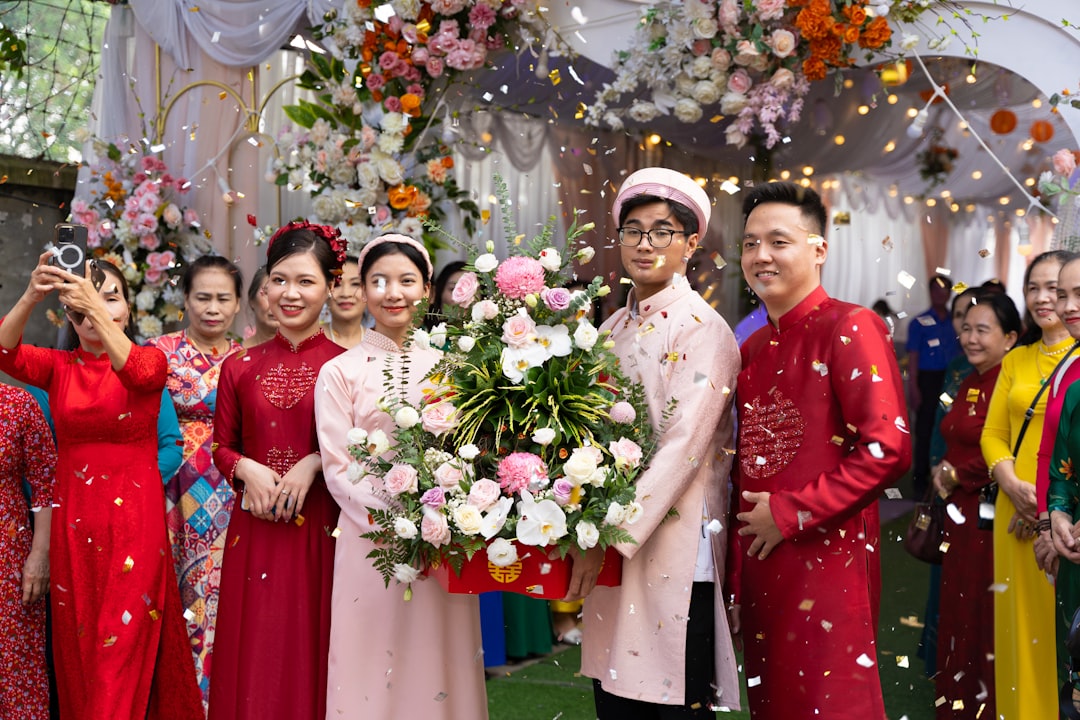
The đám hỏi procession — a formal, joyful moment when two families come together
For Viet Kieu couples returning to Vietnam, the đám hỏi can feel both familiar and unfamiliar at once. You may remember fragments from childhood — the red trays, the áo dài, the incense at the altar — but the logistics and regional nuances might be entirely new. That gap between emotional memory and practical knowledge is exactly where a good planner adds value.
MÂM QUẢ TRADITIONS For broader inspiration, see Vogue wedding trends.
The Art of Mâm Quả: What Goes on Each Tray
The mâm quả — the ceremonial gift trays — are the visual and symbolic centerpiece of every đám hỏi. Each tray is carefully wrapped in red or pink fabric and carried by a designated member of the groom’s delegation, usually young unmarried men. The bride’s side mirrors them with young unmarried women who receive the trays.
What typically goes on the trays: The core items include trầu cau (betel leaves and areca nuts), fresh seasonal fruits, traditional cakes (bánh phu thê or bánh cốm), roasted pig (heo quay — particularly important in Southern Vietnam), tea, wine, and a cash offering in a red envelope. Some families add jewelry for the bride as a separate tray.

Mâm quả arranged with care — each item carries symbolic meaning in Vietnamese culture
How many trays? This varies by region and family preference. Southern families typically use an even number (6, 8, or 10 trays), while Northern families often choose odd numbers (5, 7, or 9). Central Vietnamese traditions may differ further. The number is usually agreed upon during the dạm ngõ — another reason that earlier ceremony matters.
A common misconception is that more trays means more respect. In practice, the quality and presentation of the gifts matter far more than quantity. A thoughtfully curated set of six trays speaks louder than ten trays assembled without intention.
PLANNING LOGISTICS
Timeline and Logistics: What a Professional Planner Coordinates
The đám hỏi may last only a few hours, but the coordination behind it begins weeks — sometimes months — in advance. Here is what a typical planning timeline looks like when our team is involved.
4–6 weeks before: Confirm the number of trays, gift contents, and delegation size with both families. This is where most misunderstandings happen, especially when families come from different regions. We facilitate these conversations directly, translating expectations between North and South, between traditional parents and modern couples.
2–3 weeks before: Source and order all gift items. Arrange the procession lineup (who carries which tray, the order of entry). Coordinate áo dài for the delegation — matching colors between both sides is customary. Confirm the schedule with both homes.

Behind every smooth ceremony is careful coordination between two families and many moving parts
Day of: Oversee the procession arrival, manage the gift presentation sequence, prompt the MC or family spokesperson at each stage, coordinate the ancestor prayer moment, and ensure the tea ceremony flows naturally. After the formal portion, we manage the transition to the celebratory gathering — photographs, toasts, and the relaxed conversation that follows.
For couples planning from overseas, we serve as the single point of contact between both families. You share your preferences and cultural priorities with us, and we handle the rest — from sourcing heo quay in District 1 to arranging áo dài fittings for your delegation.
BUDGETING SMART
How Much Does a Đám Hỏi Cost in 2026?
Budget transparency is one of the most appreciated aspects of working with a planner. For the đám hỏi specifically, the groom’s family covers the cost of the gift trays and the procession, while the bride’s family handles the home preparation and reception.
In 2026, a typical đám hỏi in Ho Chi Minh City ranges from 30 to 80 million VND on the groom’s side, depending on the number of trays, the quality of items (especially the heo quay and jewelry), and whether professional decoration is involved. In Hanoi, the range is similar, though the gift composition differs slightly.
Clear budgeting early in the process prevents surprises for both families
Where the money goes: The largest line items are usually the heo quay (5–15 million VND for a premium whole pig), jewelry and gold (if included as a separate tray), the trầu cau and fruit arrangement (3–8 million VND), and professional wrapping and decoration of the trays (2–5 million VND). The cash offering — typically placed in a red envelope on the final tray — varies widely and is a private matter between families.
Our advice: set a budget range early and communicate it to your planner. We can work within nearly any budget while maintaining the ceremony’s cultural integrity. The goal is never to overspend — it is to present each element with care and intention.
RELATED ARTICLES
More guides for your wedding journey
THE WHITE PLANNER
Your Story. Our Stage.
Planning a wedding in Vietnam is a journey of culture, creativity, and celebration. The White Planner brings clarity, beauty, and calm to every step — so all you need to do is show up and say yes.